EcoFlow vs Jackery: Which Power Station Fits Camping and Van Life?
This post may contain affiliate links. If you buy through them, we may earn a commission at no extra cost to you.
Table of contents
- The short answer
- Side-by-side comparison
- Which size do you need?
- Mid size: RIVER 2 Max 500 vs Explorer 500 v2
- Van size: DELTA 3 Classic vs Explorer 1000 v2
- Large: DELTA 3 Max vs HomePower 2000 Plus v2
- What about BLUETTI?
- Pairing with solar
- Frequently asked questions
- Is EcoFlow or Jackery better?
- What size power station do I need for van life?
- Can a power station run a 12V fridge?
- Do these work with solar panels?
EcoFlow and Jackery make most of the portable power stations you’ll see at campsites and in van builds. Both brands now use LiFePO4 (lithium iron phosphate) batteries in the models below, which last thousands of charge cycles, so the choice comes down to smaller things: how fast it recharges, how much it weighs, and how far you can expand it.
This guide compares them size by size, so you’re weighing like against like. Specs come from each brand’s listings and retailer spec sheets. Where sources disagreed, we left the number out rather than guess. We haven’t run these units through our own tests.
The short answer
- Pick EcoFlow if fast recharging matters most. The DELTA 3 Classic reaches 80% from a wall outlet in about 45 minutes, which helps when you only have shore power for a short stop.
- Pick Jackery if weight matters most. At the 1,000 Wh size, the Explorer 1000 v2 is about 3 pounds lighter than the DELTA 3 Classic and slightly bigger in capacity.
- For most van lifers, the 1,000 Wh size is the sweet spot. It runs a 12V fridge, lights, a fan, and laptop charging through a typical day, and it’s still light enough to carry.
Side-by-side comparison
| Size | Model | Capacity | AC output | Battery | Weight |
|---|---|---|---|---|---|
| Mid | EcoFlow RIVER 2 Max 500 | 499 Wh | 500W | LiFePO4 | About 13 lb |
| Mid | Jackery Explorer 500 v2 | 512 Wh | 500W | LiFePO4 | 13.3 lb |
| Van size | EcoFlow DELTA 3 Classic | 1,024 Wh | 1,800W | LiFePO4 | 26.7 lb |
| Van size | Jackery Explorer 1000 v2 | 1,070 Wh | 1,500W | LiFePO4 | 23.8 lb |
| Large | EcoFlow DELTA 3 Max | 2,048 Wh | 2,400W | LiFePO4 | About 45 lb |
| Large | Jackery HomePower 2000 Plus v2 | 2,048 Wh | 2,400W | LiFePO4 | 40.6 lb |
Which size do you need?
Add up what you’ll run in a day. Capacity is measured in watt-hours (Wh): a 1,000 Wh station can, in theory, supply 1,000 watts for one hour or 100 watts for ten hours. In practice you get somewhat less than the rated number once inverter losses are counted, so leave some margin.
- About 500 Wh: weekend camping, phones, laptops, lights, a CPAP for a night or two, and short runs of small appliances.
- About 1,000 Wh: daily van life with a 12V compressor fridge, lights, a fan, and devices. With solar panels topping it up, this size can often keep up with daily use on sunny days.
- About 2,000 Wh: full-time living with more power-hungry gear, like an induction cooktop, a coffee maker, or power tools, or home backup during outages.
The output rating (in watts) matters too. It’s the most the station can deliver at once. A 500W unit won’t run a 1,000W hair dryer, even with a full battery.
Mid size: RIVER 2 Max 500 vs Explorer 500 v2
These two are close to identical on paper: about 500 Wh, 500W output (with roughly 1,000W short peaks), LiFePO4 batteries, and around 13 pounds.
The difference is charging. EcoFlow says the RIVER 2 Max 500 charges from 0 to 100% on a wall outlet in about an hour, and it accepts up to 220W of solar. Jackery lists the Explorer 500 v2 at about 1.3 hours on wall power, with up to 200W of solar. If you’ll mostly charge from the sun, the solar inputs are close enough that either works.
EcoFlow RIVER 2 Max 500 Portable Power Station, 499Wh LiFePO4
- 499 Wh LiFePO4 battery, 500W AC output
- About 1 hour to full on a wall outlet, per EcoFlow
- Up to 220W solar input
Jackery Explorer 500 v2 Portable Power Station, 512Wh/500W
- 512 Wh LiFePO4 battery, 500W AC output
- About 1.3 hours to full on wall power, per Jackery
- Up to 200W solar input; 13.3 lb
Van size: DELTA 3 Classic vs Explorer 1000 v2
This is the matchup most van lifers are really deciding between.
The EcoFlow DELTA 3 Classic has more output, 1,800W versus 1,500W, so it handles bigger loads like a small microwave or an electric kettle more comfortably. It also charges faster: EcoFlow says 80% in about 45 minutes and a full charge in about an hour on AC.
The Jackery Explorer 1000 v2 is lighter, 23.8 pounds versus 26.7, and holds slightly more energy at 1,070 Wh. Standard wall charging takes about 1.7 hours. Jackery also offers a one-hour emergency charge mode, switched on in its app, for when you need power fast.
If you mostly recharge from solar while parked, the Jackery’s lighter weight and extra capacity may matter more than charging speed. If you recharge at campgrounds or from shore power between drives, the EcoFlow’s speed is the bigger advantage.
EcoFlow DELTA 3 Classic Portable Power Station, 1024Wh 1800W
- 1,024 Wh LiFePO4 battery, 1,800W AC output
- 80% in about 45 minutes on AC, per EcoFlow
- 26.7 lb
Jackery Explorer 1000 v2 Portable Power Station, 1070Wh 1500W
- 1,070 Wh LiFePO4 battery, 1,500W AC output (3,000W surge)
- About 1.7 hours on wall power; 1-hour emergency mode via the app
- 23.8 lb
Large: DELTA 3 Max vs HomePower 2000 Plus v2
Both hold 2,048 Wh and deliver 2,400W, enough for an induction cooktop or power tools, and both use LiFePO4 batteries.
The Jackery HomePower 2000 Plus v2 is lighter at 40.6 pounds and expands further: Jackery says you can add up to five battery packs for as much as 12 kWh, which makes it a strong pick if you also want home backup.
The EcoFlow DELTA 3 Max focuses on charging speed. Retailer specs list 80% in about 68 minutes with an 1,800W charging input. At about 45 pounds, it’s the heavier of the two.
At this size, neither is something you’ll carry far. Think of these as units that live in the van or the garage.
EcoFlow DELTA 3 Max Portable Power Station, 2048Wh LFP, 2400W
- 2,048 Wh LiFePO4 battery, 2,400W AC output
- 80% in about 68 minutes at 1,800W input, per retailer specs
Jackery HomePower 2000 Plus v2 Power Station, 2048Wh, 2400W
- 2,048 Wh LiFePO4 battery, 2,400W AC output
- Expandable to 12 kWh with up to five battery packs, per Jackery
- 40.6 lb
What about BLUETTI?
BLUETTI is the other major name in portable power, with LiFePO4 stations in similar sizes. If neither EcoFlow nor Jackery fits your needs or budget, it’s worth comparing at the same capacity and output.
Pairing with solar
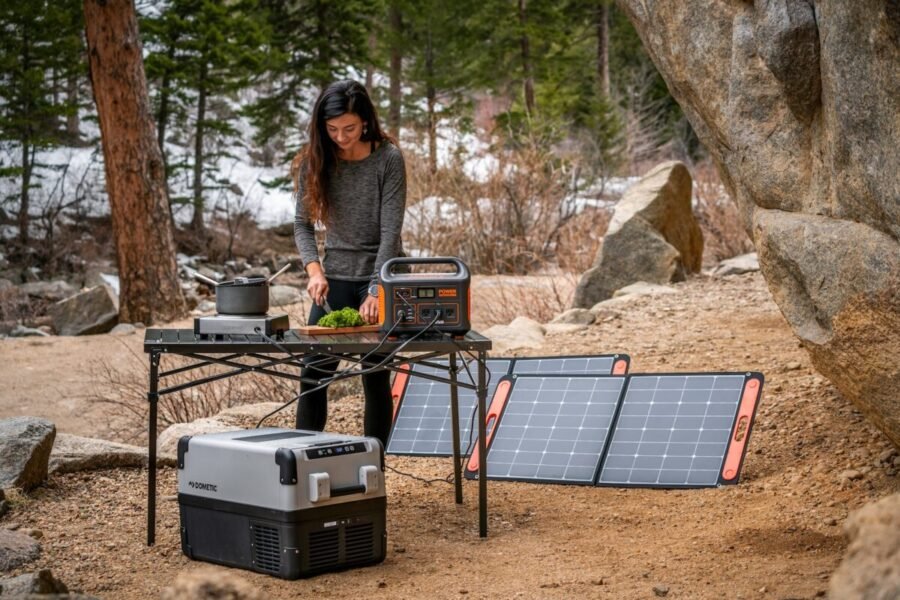
A power station on its own is just a battery. To stay off-grid for more than a couple of days, you’ll want folding solar panels to recharge it. Match the panels to the station’s maximum solar input, and remember that real-world solar output is usually well below the panel’s rating. Our guide to solar chargers and panels covers panel sizes from 100W to 220W that pair with these stations, and our post on portable solar panels for van life covers the basics.
Frequently asked questions
Is EcoFlow or Jackery better?
Neither is better across the board. In the models above, both use long-lasting LiFePO4 batteries. EcoFlow generally charges faster on AC power, and Jackery is generally lighter at the same size. Choose based on which of those matters more for how you camp or travel.
What size power station do I need for van life?
For most people, about 1,000 Wh. That’s enough for a 12V fridge, lights, a fan, and devices through a typical day, especially with solar panels recharging it. Go to 2,000 Wh if you plan to cook with electricity or run power tools.
Can a power station run a 12V fridge?
Yes. A 12V compressor fridge draws power in cycles, not constantly, so a 1,000 Wh station can typically run one for a day or more. The exact runtime depends on the fridge, the outside temperature, and how often it’s opened. Check your fridge’s average daily consumption and compare it with the station’s capacity.
Do these work with solar panels?
All of them accept solar input. Check each model’s maximum solar input before buying panels, and match the connector type, or plan on an adapter.
Product versions, prices, and availability change often. Check the current listing before you buy.